Showing posts with label Dwyer. Show all posts

Monday, October 28, 2013

The Colemans & Dwyers: More Australian Cousins

This is the tenth post in a series about my Coleman and Dwyer ancestors.

Honora Dwyer and Bryan Sheehan with their children

In my previous post, I talked about our Coleman relatives who remain in Australia. There are also a large number of Dwyer cousins who live in Australia, New Zealand and Tasmania.

Mary Dwyer Coleman was one of eleven children born to John Dwyer and Johanna Burke Dwyer in Tasmania. Our family continues with the descendants of Mary’s siblings.

Children of John Dwyer and Johanna Burke Dwyer:
  1. TIMOTHY DWYER, born unknown; died June 27, 1900 in Tasmania
  2. MARGARET DWYER, born July 13, 1855 in Tasmania
  3. CATHERINE ALICE DWYER, born July 12, 1857 in Deloraine, Tasmania. She married John Gaffney in 1885.
  4. HONORA ANGELINE DWYER, born February 15, 1858 in Deloraine, Tasmania; died June 14, 1941. She married Bryan Sheehan in 1879.
  5. HAROLD DWYER, born December 15, 1858 in Tasmania
  6. MARY DWYER, born September 25, 1861 in Tasmania; died October 27, 1905. She married Andrew Mark Coleman in 1885.
  7. JULIA MAUD DWYER, born August 9, 1865 in Port Sorrell, Tasmania; died May 19, 1890 in Tasmania.
  8. SARAH DWYER, born about 1868 in Tasmania; died June 14, 1876 in Tasmania
  9. PHILIP PATRICK DWYER, born about 1869 in Tasmania; died August 5, 1943. He married Mary Steers in 1897.
  10. ELIZABETH ANN DWYER, born about 1873 in Tasmania; died June 3, 1880 in Tasmania
  11. JOHN DWYER, born November 15, 1878 in Launceton, Tasmania; died November 3, 1954 in Gisborne, New Zealand. He married Irene Perkins.

Here is what I know about Mary’s siblings:

Philip Patrick Dwyer married Mary Ann Steers. They had five children: John Dwyer, Ada Alice Dwyer, William Dwyer, Philip Dwyer and George Dwyer.

Honora Dwyer married Bryan Sheehan. They had twelve children:
  1. JULIA MAUD SHEEHAN, born 1879 in Sassafras, Tasmania; died 1961. She married Richard John Button.
  2. MICHAEL SYLVESTER SHEEHAN, born 1881; died 1965. He married Elsie Bennett.
  3. JOHN FRANCIS SHEEHAN, born 1883 in Latrobe, Tasmania; died 1970.
  4. DENIS AMBROSE SHEEHAN, born 1885; died 1953. He married Alice Eliza Parker.
  5. PHILIP PATRICK SHEEHAN, born 1887 in Sassafras, Tasmania; died 1946. He married Ida Eleanor Smith.
  6. BERNARD BRYAN SHEEHAN, born 1889; died 1970. He married Maude Parker.
  7. ALFRED SHEEHAN, born 1890; died 1898.
  8. JOSEPH RONALD SHEEHAN, born 1891 in Latrobe, Tasmania; died 1971. He married Winifred (surname unknown).
  9. HONORA ANGELINE SHEEHAN, born 1893; died 1991.
  10. GEORGE REGINALD SHEEHAN, born 3 November 1895 in Mersey, Tasmania; died 1941. He married Marjory Beryl Isaac.
  11. JOHANNA MAY SHEEHAN, born 3 November 1895; died 1952.
  12. xii. LEONARD RALPH SHEEHAN, born 1897; died 1899.
Honora Dwyer and Bryan Sheehan

Sheehan brothers: Phillip, Bernard and (likely) George

Phillip Sheehan and Ida Smith

John Dwyer married Irene Perkins. They settled in New Zealand had five children: Florence "Joyce" Dwyer, Colleen Dawn Dwyer, Beverly Irene Dwyer, Mollie Wilson Dwyer and John Thomas "Jack" Dwyer. Their descendants remain in New Zealand.

Sisters: Mollie and Joyce Dwyer

Jack Dwyer with wife Judy Read

Catherine Alice Dwyer married John Gaffney in 1885. They had six children:


1. HUGH FRANCIS GAFFNEY, born 1886 in Emu Bay, Tasmania; died July 1945. He married Alice Maud Smith.
2. ALICE STANISLAUS GAFFNEY, born March 20, 1888 in Warratah, Tasmania; died July 8, 1959. She married John George Russell.
3. FRANCES MAUD LILLIAN GAFFNEY, born April 30, 1890 in Warratah, Tasmania; died 1967 in Tasmania. She married Sydrick James Hay.
4. JOSEPHENE VERONICA GAFFNEY, born April 1, 1893 in Warratah, Tasmania.
5. JOHN ALFRED GAFFNEY, born July 13, 1896 in Strahan, Tasmania; died February 28, 1977. He married Phyllis Martha Collidge.
6. CHRISTINA SYBIL GAFFNEY, born August 30, 1892 in Strahan, Tasmania; died December 5, 1898 in Strahan, Tasmania.

Hugh Francis Gaffney

The cousins listed above have many children and grandchildren still living in Australia, Tasmania and New Zealand.  

Sunday, October 20, 2013

The Colemans & Dwyers: Our Australian Cousins

This is the ninth post in a series about my Coleman and Dwyer ancestors.


My great-grandmother, Kathleen Coleman, emigrated from Melbourne, Australia to America in 1919. However, she had relatives who stayed in Australia, Tasmania and New Zealand. These families remain there to this day.

Kathleen’s brother Albert died as a boy. Her sister, Maggie, seems likely to have died as a young woman, since I can find no record of her after 1905. Our relatives still in Australia descend from Kathleen’s aunts and uncles, not her siblings. I will first discuss the relatives from her father’s family, the Colemans.

Andrew Coleman’s sister, Ann Nora Coleman*, married Peter Doyle on September 30, 1885 in Merino, Victoria, Australia. They had six children.
  1. CATHERINE AGNES DOYLE, born 1886 in Sandford, Victoria, Australia; died 1956. She married Denis Patrick Ryan.
  2. ALICE MARY DOYLE, born 1887 in Muntham, Victoria, Australia; died 1970. She married Edward John Flynn.
  3. MAUD BRIDGET BOYLE, born 1889 in Sandford, Victoria, Australia; died 1967. She married John Patrick Dineen.
  4. JOHN ANDREW “JACK” DOYLE, born 1893 in Sandford, Victoria, Australia. He married Mary Ellen Heenan.
  5. AGNES HONORA DOYLE, born 1897 in Casterton, Victoria, Australia; died 1969. She married Edward Buron on May 17, 1927 in Casterton.
  6. HONORA FRANCES DOYLE, born 1900; died 1900.

You’ll notice the repetition of family names amongst the names of these children. We believe that Ann Nora and Andrew’s maternal grandmother was named Honora. One child has the middle name, Bridget, like Ann Nora and Andrew’s mother. Two more have the middle names Mary and Andrew, like Ann Nora’s siblings. Alice was the name of Peter Doyle’s mother.

Here is what I know about these individuals and their descendants:

Catherine Agnes Doyle married Denis Patrick Ryan in Victoria, Australia in 1912. They had seven children, James, Joyce, Kathleen, Thomas, William, Yvonne and Agnes Nora Ryan. The children of Catherine and Denis remained in the Melbourne area.


Catherine Agnes Doyle (source)

Alice Mary Doyle married Edward John Flynn in 1911. They had four children, Charlie, Jack, Jim and Mary Nora Flynn. They also appear to have largely remained in and around Melbourne.

John Andrew “Jack” Doyle served in World War I in the 5th Machine Gun Battalion, AIF (Australian Imperial Force). He enlisted in 1915 and returned to Australia in 1919. His unit appears to have spent the war fighting in France, but I am still researching the specifics of Jack’s military service. He married Mary Ellen Heenan and they had three daughters, Maureen Agnes, Clare and Enid Honora Doyle.

Agnes Honora Doyle married Edward Burton in Casterton, Victoria, in 1927. They had two sons, John and Kenneth Burton, both of whom lived and died in Victoria and had children there. These children are my third cousins once removed.


Agnes Honora Doyle (source)


*Ann Nora Coleman is listed in some online family trees as actually being named Honora Coleman. This would make sense, given that Honora was her grandmother’s name, but I don’t have any proof of it. Other sources, including Australian birth, death and marriage records, list her as Ann Nora, so I’m sticking with that name until proved otherwise.

Saturday, October 12, 2013

The Colemans & Dwyers: Kathleen Coleman In America

This is the eighth post in a series about my Coleman and Dwyer ancestors.

Kathleen Coleman, center, on board the ship to America.  Her friend Florence is beside her.

At the age of nineteen, Kathleen Coleman found herself essentially orphaned. Her mother was dead and her father was incommunicado in South Africa. Her younger brother, Albert, had died years earlier. Kathleen and her sister, Maggie, were left to fend for themselves. We know very little about what happened during the years between 1905, when Mary Dwyer Coleman committed suicide, and 1919, when Kathleen sailed to America. I believe that Maggie Coleman died sometime in these years, but I have not found a death record for her. I'm continuing to work on this.

Kathleen Coleman sailed from Australia to Canada in 1919, arriving in Vancouver in October of that year. Photos of her voyage show her nicely dressed and lounging on deck with a group of smiling friends. In this group was her best friend, Florence Cornish, with whom she shared a strong and lasting bond.   Florence and Kathleen traded photos and letters regularly for the rest of their lives.

After arriving in Vancouver, Kathleen sailed to Seattle. The ship’s manifest lists her as a bookkeeper whose final destination was San Francisco. On the manifest, Kathleen states that she has no family in the country of her origin, but does say that her mother was Mary of Melbourne. However, Kathleen did not settle in San Francisco. She headed south to Los Angeles, where she met her future husband.


Kathleen Coleman and George Beck on their wedding day. Los Angeles, 1921.

On September 21, 1921, Kathleen Coleman married George Beck (formerly Gerhardus Marinus Beukenkamp), a Dutch immigrant, in Los Angeles, California at City Hall. Kathleen’s friend Florence Cornish was a witness at the ceremony.

Kathleen and George's marriage record.

 Kathleen and George settled in Eagle Rock, California, a town located just northeast of Los Angeles. They had two daughters, Margaret Florence Beck and Jeanette Mary Beck. George first owned a used car lot and then was the owner and operator of a hardware store. With the advent of World War II, George could no longer get materials to stock the hardware store. In 1943, he sold the property and moved with his family to Fallbrook, a small country town in northern San Diego County.

Kathleen with daughters Margaret and Jeanette in Eagle Rock.  Around 1928.

In Fallbrook, George bought twenty-three acres of land and an adobe house. In 1955, he sold the upper five acres, including the home, to his daughter Jeanette and her husband David Lacey. George and Kathleen moved to Del Mar. Kathleen became ill in 1970 and was sent to Tri-City Hospital in Oceanside. From there, she was transferred to a convalescent home in Fallbrook, where she died on February 27, 1970. George lived in Del Mar until his death on July 2, 1973.

For all the turmoil and heartbreak Kathleen encountered during the years of her childhood, she seems to have been amazingly resilient. Those who knew her recall her warmth, humor, and devotion to her daughters. If she had not made the brave decision to cross an ocean alone and start a new life in a foreign country, none of us would be here.

Next, some final thoughts on the Colemans and Dwyers, plus information about the relatives who remain in Australia, Tasmania and New Zealand.


Sunday, October 6, 2013

The Colemans and Dwyers: Andrew Coleman


This is the seventh post in a series about my Coleman and Dwyer ancestors.

The location of Durban, South Africa is noted with an "A."

Continuing the story of my Coleman and Dwyer ancestors, I wanted to focus a little on Andrew Coleman. It was really the mystery of what happened to him that set me on the quest to discover more about this family in the first place. He was not in Melbourne with his family when Mary Dwyer Coleman committed suicide, and Kathleen Coleman’s deposition refers to his absence and the circumstances surrounding it. Here’s what we know.

Andrew Coleman left Australia in 1903 and went to South Africa, which we know from Kathleen’s statement to the coroner. It’s not clear what he was doing there, but Kathleen indicates that her father, “Meant to better his condition.” None of the information I’ve found at this point points to an occupation for Andrew in Africa. However, as I mentioned in my last post, we at least now know exact where Andrew was living. At the time of Mary’s death in 1905, he was living in Durban, on the northeast coast of South Africa.

The Durban History Museums website tells us about the population and primary occupation in Durban in the early 1900s.

In the early years of the twentieth century Durban's population level was relatively low. In 1900 the total population of the town was about 55,700 of whom 14,600 were African.

It seems that during the years of Andrew Coleman’s residency, areas of employment in this port city included dock work, coal storage, and servicing of incoming ships. Durban was also known for its beer production and beer halls.

Kathleen’s statement to the coroner in 1905 makes it clear that Andrew had not had the success he’d hoped for in South Africa. He had been out of touch for some time and hadn’t sent any money home to his family. From what Granny told us about Andrew Coleman being killed by Zulus, my first thought was that Andrew had probably died in Africa. However, I found a death record for him in Ballarat, Australia in 1941.


Andrew Coleman died on October 2, 1941 at the Benevolent Home in Ballarat. The cause of his death was listed as cardiac degeneration. He was 82 years old. On his death certificate, Andrew’s usual place of residence is listed as Trafalgar, although I’m not sure what that means. I cannot find a town named Trafalgar in the area, nor a Trafalgar Street in Ballarat. There is a city of Trafalgar located three hours drive southeast of Ballarat, but this seems quite far from Ballarat to be the correct location. There is a city called Trafalgar about a 90 minute drive south of Durban, in KwaZulu-Natal, South Africa. It is possible that Andrew had settled there after his time in Durban, but we don't know.

On the death certificate, Andrew Coleman’s occupation is listed as “coach builder.” The certificate states that Andrew was married in Melbourne at age 26 to Mary Dwyer and was a widower at the time of his death. Where there is a space to list children, the only entry is this: "Mary, 52 years." This is perplexing. If Andrew had a child named Mary, this would make her date of birth 1888/1889. Andrew’s daughter Margaret was born in 1888 but we don’t believe she ever went by the name Mary. There are three possibilities here: (1) This inclusion of Mary is a mistake and he had no daughter by that name or of that age (2) The name is written incorrectly and should have been listed as Maggie (3) He had another daughter we are not aware of named Mary. As of now, this is a mystery. We do not know why Kathleen and Maggie are not listed, but an unknown child named Mary is listed.

It’s not clear when Andrew Coleman returned to Australia from South Africa, or what kind of relationship he had with Kathleen and Maggie after their mother’s death. We don’t believe that Kathleen was ever in communication with her father after going to America.

Next, I'll talk about Kathleen's emigration to America.

Monday, September 30, 2013

The Colemans & Dwyers: In the News


This is the sixth post in a series about my Coleman and Dwyer ancestors.


When I last posted, I related the circumstances of Mary Dwyer Coleman’s suicide, and the statements given to the coroner by her family members.

I’ve also found a newspaper article that mentions this incident and provides additional insight. This is from The Argus in Melbourne, Victoria, Australia and was printed on Saturday, October 28, 1905.

Casualties and Fatalities
Woman Shoots Herself
Yesterday evening a married woman named Mary Coleman, 44 years of age, committed suicide by shooting herself with a revolver. On Thursday, Mrs. Coleman, with her two daughters, took a house at No. 3 Church Street, South Melbourne, with Mrs. Brown and her family. Between 5 and 6 o’clock Mr. William Brown asked Miss Coleman to call her mother to tea. The girl found the door was locked. Mr. Brown forced the door and found Mrs. Coleman lying on the floor in a pool of blood. Constable Power found that the woman had shot herself in the ear. A new six-chanbered revolver was lying on the floor with five chambers loaded. Mrs. Coleman’s husband is at present living in Durban, South Africa. She was an outpatient attending the Women’s Hospital who was to have been admitted to that institution today for an internal complaint. Her daughter states that her mother has been very despondent of late and only last week a revolver was found under her pillow. The body was removed to the morgue.

This told me a couple of new facts that I had not known previously. Firstly, Andrew Coleman was in Durban. I had not been aware of his exact location in South Africa prior to reading this article. Secondly, Mary Dwyer Coleman was due to be admitted to the hospital for an “internal complaint.” Her daughter Kathleen had mentioned this same ailment in her deposition, but I did not know until reading this article that there was a looming hospitalization. Perhaps Mary was due to have a surgery? We can only speculate. This article helps shed additional light on the Coleman family’s situation at the time of Mary’s death, however. Next, we will talk about the whereabouts of Andrew Coleman.

Thursday, September 19, 2013

The Colemans & Dwyers: Further Statements


This is the fifth post in a series about my Coleman and Dwyer ancestors.

3 Church Street, South Melbourne

 In my last post, I wrote about the tragic suicide of my great-great grandmother, Mary Dwyer Coleman.  After her death, Mary's eldest daughter, Kathleen, gave a statement to the coroner.  Three others, including Mary's youngest daughter, Maggie, also made statements.  While these statements were not easy to read and are full of illegible words and confusing phrasing, I have transcribed them here as best as possible.

Statement by Charles Nolan to the Coroner:

This Deponent: Charles Nolan
On his oath saith, I am a constable of police at stationed at Burke St. West

Deceased was married to my step brother.  I saw her last Thursday she was at my place most of that day.  I spoke to her about the revolver.  I was at her house when her daughter gave me the revolver.  She told me that she bought it with the intention of shooting herself but had refunded it immediately after.  We took the revolver back to where she bought it.  From that time I thought she should have been looked after.  I intended to take steps to have her looked after.  I think she was depressed at times.  It put me off my guard when I saw her so well.

Charles Nolan
Taken and sworn before me the 30th day of October 1905 at Melbourne

This letter tells us that Andrew’s step-brother Charles had a relationship with Mary and her children, and may have even been looking after them in Andrew’s absence.  Charles certainly was aware of Mary’s troubled state prior to her death.

Statement by Mr. Brown to the Coroner:

This Deponent: William John Brown
On his oath saith, I am laborer residing at 3 Church St South Melbourne

I have seen the body of the deceased.  I last saw her alive last Friday evening about 6pm the 27th  (?).  She was in the bedroom.  I do not know if she was dead.  I saw her alive at a quarter to six(?) in the evening.  She was in the dining room.  She had very little to say.  I am not any relation to her.  She made a statement to me last Monday 23rd (?) that she would take her daughters’ life.

I said “How do you feel Mrs. Coleman” she said “I do not feel well at all.”  I told that to the girls on last Thursday.  I did not think she intended it.  I did not go with her to the Hospital.  She left the room where I last saw her alive.  I heard a noise like a shot.  We thought it was a latch.  The room she was in was upstairs.  She had left the room about ¼ of an hour before we heard the noise.  I went up into the room.  About 6.20pm one of the girls went up and called deceased to her.  She called out “mother” but got no answer.  She came down stairs again.

I went up to the bedroom.  The door was shut with a (?) behind it.  I had to shove the (?) to get in.  (?) the deceased on the floor with her head on the bed.  No one was with me.  I saw blood.  I went downstairs and told the (?) to go for the police.  I do not know if the window was open.  I left the deceased and the room as I found it till the constable came.  I did not believe that the deceased was in earnest when she said she would do away with the girls.

When I (?) the girls after Thursday was before the time she told me she would do away with them.  I do not know where she got the revolver (produced).  I did not see it before.  She seemed very funny at times.  I did not suspect she would take her life.  I did not think she wanted watching.  I could not say if she should have had medical advice.

William John Brown
Taken and sworn before me the 30th day of October 1905 at Melbourne


 We don't know how long Mr. Brown had known Mary Dwyer Coleman, but he hadn't been sharing a house with her for very long prior to the suicide.

Statement by Maggie Coleman to the Coroner:

This Deponent: Maggie Coleman
On her oath saith, I am residing at 3 Church St South Melbourne

I am a daughter of the deceased.  I have heard my sister’s(?).  It is correct as far as I know.
I went to (?) with my sister last Friday.  The house was divided.  The other people Mr. Brown and the two Mrs. Browns were in the other half of the house.  I am 17 years of age.

I got home at ½ past 6.  Mr. Brown told me that my mother was upstairs waiting for tea.  I was not home when deceased [took] her life.  I came home after.

Maggie Coleman
Taken and sworn before me the 30th day of October 1905 at Melbourne

It is not clear what happened to Kathleen and Maggie after their mother’s death.  They were 19 and 17, old enough to be working and earning their own money.  It is not known if they stayed on Church Street or moved elsewhere.  The next thing we know for sure about the family is that in 1919, at the age of 33, Kathleen Coleman boarded a ship headed to Vancouver with a group of her friends and left her homeland behind forever.  

In my next post, I'll talk about the fate of the absent Andrew Coleman.

Tuesday, September 17, 2013

The Colemans & Dwyers: The Death of Mary Dwyer Coleman


This is the fourth post in a series about my Coleman and Dwyer ancestors.

Footscray Cemetery.  Mary Dwyer Coleman and her son Albert are buried in unmarked graves near this spot.

When you research family history, you come across some sad stories. I’ve discovered ancestors who were killed in massacres, accused of witchcraft, drowned in storms at sea and succumbed to now-preventable disease. There is great tragedy in the past. However, learning the fate of Mary Dwyer was particularly shocking and very difficult to process. It was the first time in my research that I really paused to consider what this information would mean to others in my family. Did I want to pick up the phone and tell my father what happened to his great-grandmother, the mother of the grandmother he adored? Was it just too sad and awful? Eventually, I did relay this story to my father, and then to the rest of our family, but it still makes me a little uncomfortable. Did my Granny know about this? Did her mother keep it a secret? Would she have wanted us to know, or would she be upset by my discovery? I don't know the answers to these questions. This story does, however, give me extra admiration for Kathleen Coleman, who rose above a calamitous childhood, immigrated to America and raised two lovely daughters. Her survival is the reason I am here.

Our clearerst glimpse into the lives of the Coleman family in Melbourne occurs in 1905. On October 27, 1905, Mary Dwyer, aged 44, committed suicide in the home where she was living with her daughters. Kathleen was not at home when Mary shot herself in her bedroom, but it appears that her younger sister, Maggie, arrived home not long afterward. Mary’s body was discovered by the family that shared the house, the Browns, and they sent someone, either Maggie or one of the Brown women, to summon the police.

At the time of Mary’s suicide, the family was living at 3 Church Street in South Melbourne. Mary, Kathleen (19) and Maggie (17) had been sharing a home with the Brown family, comprised of Mr. William Brown, his wife and his mother. In the statements given to the police after the suicide, it is revealed that Andrew Coleman had gone to South Africa two years prior to Mary’s death and that the family had had virtually no communication from him. I have found news articles in Melbourne that indicate he may have been a heavy drinker, arrested on more than one occasion for public intoxication.  The statements given by Kathleen, Maggie, Mr. Brown and Andrew Coleman’s step-brother Charles Nolan also reveal that Mary Dwyer had been seriously depressed for some time, had been seeking help for health issues at the local hospital, and had previously threatened suicide on at least one occasion.  She had also threatened to kill her children. While the statements are full of misspellings, indecipherable words and confusing phrasing, they lay out clearly the events of the day and the circumstances leading up to the suicide.

Statement by Kathleen Coleman to the Coroner:

This Deponent: Kathleen Coleman
On her oath saith, I am residing at 3 Church St. South Melbourne

I have seen the body of deceased at the morgue and identify it as that of my mother Mary Coleman. My father’s name is Andrew Coleman. 

She was 44 years of age and lived at South Melbourne. I was not at home when my mother was found dead. I know nothing about the shooting. I last saw my mother alive last Friday morning at 8am. My sister took her breakfast to her. My mother was not in good health.  She had been attending the women’s hospital, she went about a fortnight ago. She was very depressed and had threatened to take her life. I always slept in the same room as her. She did not sleep well. She has been more depressed last week, and she said all pains(?) had left her since the previous Sunday(?). I knew she had a revolver. I have not seen the revolver (produced). I saw a revolver last Wednesday (the 1?) My mother took it from a chest of drawers that evening and told me that she bought it on the previous Wednesday. I have no brothers. My father is in South Africa. I have a sister she is 17 years of age and is present.

I screamed when I saw the revolver and my sister came and saw it. When I left the house last Friday there was a Mr. Brown and Mrs. Brown at the house. We had half the house. I did not tell them. I told them that I had found a revolver. I believed that my mother would take her life. She threatened to take our lives also. I am 19 years of age. She was always telling other people that she would take our lives. I did not call Dr. (Rothwell?) or Dr. Hall. I went with her to the Hospital. My sister did not go to the hospital. I have no idea where she got the revolver. I know of no reason why she took her life except she was so miserable on account of her illness. I did not think she would get another revolver, as she said she would not get another.

She was without want. My father has been in South Africa 2 years last July. I (?) that preyed upon her mind. He only sent two letters and no money. They did not part in anger. He meant to better his condition. By his letters he was not successful. He(?) did not live happily with in my mother’s (habits?) were temperate. My father’s were not. My mother had a bad head also a internal complaint. She did not leave any letters referring to her death. She was not a (determined? deformed?) woman.

Kathleen Coleman
Taken and sworn before me the 30th day of October 1905 at Melbourne

This letter indicates that the marriage of Andrew Coleman and Mary Dwyer had not necessarily been a happy one, although it also appears Mary did not think Andrew was leaving their family permanently when he went to South Africa. It alludes to Andrew’s drinking problem. In two years away, he’d sent his family only two letters and no money, which could not have made them think fondly of him.

It also sounds as though, in addition to her mental condition, Mary Dwyer may have been experiencing physical pain that drove her to suicide. The words “illness” and “internal complaint” hint at a problem other than simply depression.

It's heartbreaking to think of my 19-year old great-grandmother experiencing this kind of family tragedy.  She must have been very strong to get through such a difficult situation.  

The next post will contain more statements to the coroner, and news about the fate of Andrew Coleman.

Saturday, September 14, 2013

The Colemans & Dwyers: The Marriage of Mary and Andrew


This is the third post in a series about my Coleman and Dwyer ancestors.

St Francis Catholic Church in Melbourne, where Mary and Andrew wed.

In the last two posts, I discussed the Irish origins of the Dwyer and Coleman families and where they lived in Australia and Tasmania after leaving Ireland. This brings me to Andrew Coleman and Mary Dwyer, my great-great-grandparents.

Mary Dwyer and Andrew Coleman were married in Melbourne in 1885. Their marriage certificate reveals that at the time of the union, Mary was 23 years old, working as a servant and living in Hotham. The mention of Hotham is a little confusing because there is a mountainous ski destination called Hotham several hours northeast of Melbourne. However, it seems more likely that Hotham in this circumstance refers to a neighborhood in North Melbourne called Hotham Hill, located near Royal Park and the University of Melbourne. Making matters more confusing, both Mary and Andrew list their residence at Lonsdale Street, which is south of Hotham Hill and closer to the Yarra River. Lonsdale Street is a busy thoroughfare that runs east-west through Melbourne. Here you will find shops, churches, high-rise offices, Melbourne’s Parliament building and the Supreme Court. In the late 1800s, it was also the site of Melbourne’s most infamous brothel.

On her marriage license, Mary describes her father, John Dwyer, as a laborer. Andrew says that his father was a shoemaker. Andrew Coleman was age 26 at the time of the marriage and working as a wheelwright, someone who builds or repairs wheels for carriages. The priest who officiated at St. Francis Catholic Church in Melbourne was Michael McKernan. The witnesses who signed the marriage certificate were Sylvester Blackburne and someone by the last name of Byrne (likely Walter). Neither of the witnesses were relatives, as far as I know. 


The registration paperwork for the Coleman/Dwyer marriage.

Andrew and Mary Coleman had three children:
  1. KATHLEEN MELDON COLEMAN, born 1886 in Melbourne; died February 27, 1970 in Fallbrook, California. She married George Beck (formerly Gerhardus Beukenkamp).
  2. ALBERT COLEMAN, born 1887 in Melbourne, died 1895 in Melbourne
  3. MARGARET COLEMAN, born 1888 in Melbourne

I should mention that until undertaking this research, neither my father or I had ever heard that Kathleen’s middle name was Meldon. However, it appears repeatedly in the records of her youth, including sometimes being listed as her first name. This is still a big mystery, since Meldon is neither a popular given name in Australia, nor a family name so far as I know.

Albert died as boy of about eight years old, and is buried in Footscray Cemetery’s plot 218, alongside his mother, Mary Dwyer Coleman. The cemetery is located in the suburb of Footscray, just west of Melbourne. The graves are unmarked.

Margaret went by the nickname Maggie. Her fate is somewhat unclear to me. I know that she was alive in October 1905, as she gave a statement to the coroner upon her mother’s death. After that, we have no further record of her. I cannot find either a marriage or death record for her. My suspicion is that she died sometime between 1905 and 1919, when Kathleen immigrated to America. Had she been alive after 1919, it seems certain that the sisters would have been in touch with each other, but no photos or correspondence exist. It’s also worth mentioning that Kathleen almost certainly named her eldest child, born in 1922, after her sister.

The tragedy of losing young Albert was just the beginning of bad times for the Colemans, sadly. In the next post, I'll discuss the fate of Mary and Andrew.

Tuesday, September 10, 2013

The Colemans & Dwyers, continued


This is part two in a series about my Coleman and Dwyer ancestors.

John Dwyer, brother of Mary Dwyer

 In my last post, I talked about the Coleman family's origins in Ireland and where they settled in Australia. Now, I'm going to backtrack a bit to talk about the Dwyer family and how they arrived in Australia. The largely ill-fated union of Mary Dwyer and Andrew Coleman is approaching.

Mary Dwyer’s parents were John Dwyer and Johanna Burke. John Dwyer was born about 1816 in Mitcheltown, County Tipperary, Ireland. It is believed that his father was also named John Dwyer. Johanna Burke was born about 1834 in Ireland, presumably near Mitcheltown in County Tipperary. Her parents are said to be a George Burke and Kate Burke although I do not have conclusive proof of this. Burke and Dwyer were both very common names in County Tipperary at the time and records from the period are sparse.

John was about eighteen years older than Johanna. If this was his second marriage, I don’t have any information about the first marriage. When he and Johanna sailed to Australia in 1854, they did not have children with them. Johanna was 20 and John was 38 on that voyage. Their ship, the Maitland, departed from Plymouth, Devon, England and after months at sea arrived in Hobart, Tasmania on September 16, 1854.

The Potato Famine had ravaged County Tipperary. Almost 70,000 people died in the county between 1845 and 1850 particularly in the years 1849 and 1850. The county population fell from 435,000 in 1841, to 331,000 in 1851 and to 249,000 in 1861. The rural population declined by two-thirds in that period and the town population by nearly one-half. Charles Gavan Duffy, the Australian politician and Irish nationalist wrote of the famine years:

The whole population was dependant on agriculture. The great landlords totalled two or three hundred. The mass of the country was owned by a couple of thousand others, who lived in splendour. The peasants, almost all Catholic, did the work, and reaped a harvest in which they never shared. Rent in Ireland meant the whole produce of the soil, except a potato pit. The food of the peasants was potatoes with a little milk or salt. One half of them lived in mud cabins of one room with no windows. The island was the most ignorant and impoverished of all the Christian nations on earth. [source]

County Tipperary was at the forefront of an Irish rebellion, rooted in outrage over British reluctance to do anything to ease the Irish famine.  From History.com:

At the height of the Potato Famine in Ireland, an abortive nationalist revolt against English rule is crushed by a government police detachment in Tipperary. In a brief skirmish in a cabbage patch, Irish nationalists under William Smith O'Brien were overcome and arrested. The nationalists, members of the Young Ireland movement, had planned to declare an independent Irish republic, but they lacked support from the Irish peasantry, who were occupied entirely with surviving the famine.

By the mid-19th century, the Irish population, which suffered under the system of absentee landlords, had been reduced to a subsistence diet based largely on potatoes. When a potato blight struck the country in the 1840s, disaster ensued. Between 1846 and 1851, more than one million people starved to death, and some two million people left the country, mostly to America. With the desperate times of the famine came an increased radicalism in the Irish nationalist movement.

In 1846, O'Brien formed, with John Mitchel, the Irish Confederation, a branch of the Young Ireland movement dedicated to freeing Ireland by direct action. By 1848, the group was calling for open rebellion against the English, but Mitchel was arrested, convicted of sedition, and transported to a prison colony in Australia before the revolt could begin. Aggravated by the worsening potato famine and Mitchel's arrest, O'Brien launched an unsuccessful uprising on July 29, 1848. He was arrested and sentenced to death for treason, but his sentence was commuted to transportation to the penal colony at Tasmania.

After the failure of the Young Ireland revolt, many embittered Irish nationalists immigrated to the United States, Australia, and Canada, where they redoubled their agitation against England.

This is the environment John and Johanna Dwyer were living in prior to their emigration to Tasmania.  Although they both survived the famine, they were peasants and would have undoubtedly seen family and friends starve to death, voluntarily emigrate to other countries or be forcibly transported to Australia for crimes against the Crown. Life in Ireland in 1854 was one of poverty and limited options. 

When John and Johanna Dwyer traveled to Tasmania, they did so as bounty immigrants. This term refers to people whose passage was subsidised or paid for through one of the assisted immigration schemes that operated in the various states of Australia to encourage immigrants to Australia. A colonist chose the emigrant from England or Ireland and paid his or her passage to Australia. The emigrant would then work for the colonist. The colonial government would reimburse the colonist a bounty equal to the fare. After a certain period of time, the bounty immigrant would be free to leave the colonist’s employ and strike out on their own. This is exactly what John and Johanna did. Their early years in Tasmania appear to have been spent in Deloraine, where several of their children were born.  Later, they moved further north to Launceton, Port Sorell and Sassafras.

The official records of Tasmania at this time are a little confusing in regards to the Dwyer family. I had difficulty finding birth records for the children, and have never actually seen a birth registration for Mary Dwyer. I was only able to conclusively prove her parentage by using the information provided on her marriage license in Melbourne.   

Children of John Dwyer and Johanna Burke Dwyer 
  1. TIMOTHY DWYER, born unknown; died June 27, 1900 in Tasmania
  2. MARGARET DWYER, born July 13, 1855 in Tasmania
  3. CATHERINE ALICE DWYER, born July 12, 1857 in Deloraine, Tasmania. She married John Gaffney in 1885.
  4. HONORA DWYER, born February 15, 1858 in Deloraine, Tasmania; died June 14, 1941. She married Bryan Sheehan in 1879.
  5. HAROLD DWYER, born December 15, 1858 in Tasmania
  6. MARY DWYER, born September 25, 1861 in Tasmania
  7. JULIA MAUD DWYER, born August 9, 1865 in Port Sorrell, Tasmania; died May 19, 1890 in Tasmania.
  8. SARAH DWYER, born about 1868 in Tasmania; died June 14, 1876 in Tasmania
  9. PHILIP DWYER, born about 1869 in Tasmania. He married Mary Steer in 1897.
  10. ELIZABETH ANN DWYER, born about 1873 in Tasmania; died June 3, 1880 in Tasmania
  11. JOHN DWYER, born November 15, 1878 in Launceton, Tasmania; died November 3 ,1954 in Gisborne, New Zealand. He married Irene Perkins.

Our relative Christine Bailey, whom I met while researching our mutual ancestors, was able to find baptismal records for some of the Dwyer children.  She sent me the following information from the Catholic Archives in Tasmania:

Mary Dwyer, born September 25, 1861. Baptized September 29, 1861. Sponsors: Thomas English and Julia English.

It's interesting to note that Thomas English was also a witness to John Dwyer's will. Another witness was Bryan Sheahen, a farmer in Sassafrass who married one of John and Johanna's daughters, Honora.

John Dwyer died November 10, 1887 in Tasmania.  In 1904, Johanna Dwyer married for the second time, to Henry Cooke of Tasmania.  He had previously been married to Honora O'Brien and had children from that marriage.  Johanna was 70 years old at the time of her second marriage.  She died June 23, 1915 in Latrobe, Tasmania.  She is buried in Latrobe Cemetery, in the same plot as her first husband, John Dwyer and their children, Sarah, Elizabeth and Julia.

The grave of John and Johanna Dwyer, parents of Mary Dwyer

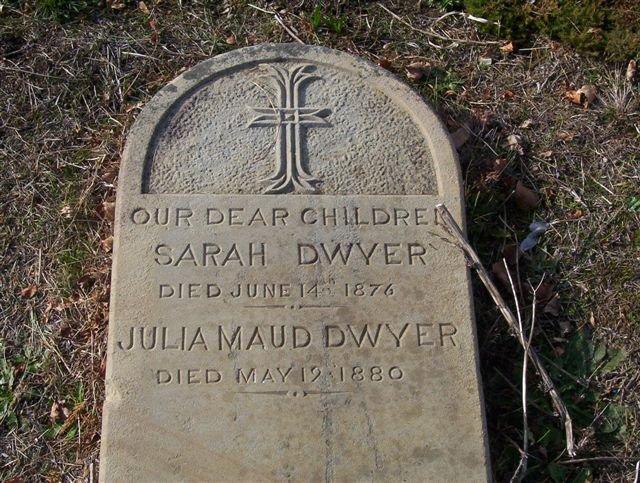
The grave of Sarah Dwyer and Julia Dwyer, sisters of Mary Dwyer


Wednesday, September 4, 2013

The Colemans & Dwyers: From Ireland to Australia to America

This is the first in a series about my Coleman and Dwyer ancestors.

Kathleen Coleman, my great-grandmother.

Growing up, I never heard my paternal grandmother talk much about her mother’s family. She’d bring up her father’s Dutch ancestry fairly often, but her mother’s background was a mystery to me until recently. I remember Granny once saying that her maternal grandfather, Andrew Coleman, was something of an unpleasant character, who’d gone to Africa and been eaten by Zulus. Knowing the way that my Granny liked to tell a dramatic story, I laughed off this idea entirely. Later, when I began researching our family’s genealogy, that story kept coming back to me. Who was Andrew Coleman, and did he really go to Africa? The search for answers turned up one of the most intriguing and tragic stories in my family’s history.

In 2007, I began working with a Melbourne-based genealogist, Peter Gill, to uncover the ancestors of Kathleen Coleman. His meticulous and thorough research was instrumental in learning more about this family and I’m deeply appreciative of his help and guidance.

Let's start with the Colemans.

Our Coleman ancestry begins with Daniel Coleman and Bridget Heaney. Daniel Coleman was born in 1824, either in Ireland or Australia. Bridget Heaney was born about 1833 in County Tipperary, Ireland. Her parents were Patrick Heaney, a farmer, and Hannah or Honorah (unreadable last name that could possibly be Bligh or Blighe).

My hunch is that Daniel and Bridget were both born in Ireland and married there prior to sailing to Australia, but that is not certain. I have not yet been able to locate any passenger lists mentioning either of them. It does appear that Daniel and Bridget were married prior to 1859 and had the following children:

  1. ANDREW MARK COLEMAN, born 1859 in Redruth, Victoria, Australia; died October 2, 1941 in Ballarat, Victoria, Australia.
  2. MARY COLEMAN, born 1860
  3. ANN NORA COLEMAN, born 1862; died 1905.  Married Peter Doyle in Merino, Victoria, Australia in 1885.
The Coleman family lived in Merino, a small community located 213 miles west of Melbourne. Daniel Coleman is listed among the “first families” of Merino, an area which was first settled in 1837 by the Henty family, who set up a small farm there. The closest large city was Ballarat, located 140 miles east of Merino. Ballarat was the site of one of Australia’s largest gold rushes, and the town’s population exploded in the 1850s after gold was discovered nearby. Merino in the 1850s was home to a three-story flour mill, a shoemaking and saddle business, a post office and an inn, among other things. A Church of England private boarding school opened in 1858, followed by a Roman Catholic private school in 1861.

Merino, circa 1885.  Photo courtesy of swvic.org.

 Daniel Coleman died on March 12, 1870 in Merino, Victoria, Australia. A notice in the Hamilton Spectator newspaper on March 16, 1870 states the following:

Merino

It is with great regret that I have to announce the death of Mr. Daniel Coleman, a very old resident of this township.  He had been suffering for some time from a chronic complaint and died last Saturday morning.

On April 20, 1871, Bridget remarried Michael Nolan. She would have been in her late 30s at the time of this marriage. 

Michael Nolan was born in 1830 in County Kilkenny, Ireland. Prior to his marriage to Bridget Heaney Coleman, he’d been married for many years to Mary Byrne, who was born in County Kilkenny, Ireland in 1826 and died in Victoria, Australia in 1869. Michael and Mary Nolan had five children from their marriage, all born in Australia, the oldest of whom was just fifteen at the time of Michael’s marriage to Bridget Heaney Coleman. This means that, upon the marriage of Michael and Bridget, there were now eight children living in the Nolan household. 

These are the children of Michael Nolan and Mary Byrne, the step-siblings of our Coleman ancestor Andrew Coleman:

  1. EDWARD NOLAN, born 1856
  2. JOHN NOLAN, born 1857
  3. JAMES NOLAN, born 1860
  4. CATHERINE NOLAN, born 1861
  5. CHARLES NOLAN, born 1864; died 1920 in Melbourne, Victoria, Australia

The step-siblings seem to have formed relationships with each other and kept in touch after leaving the Nolan/Coleman home.  We know that Charles Nolan visited with Andrew Coleman’s wife Mary Dwyer Coleman in Melbourne and gave a statement to police upon her death.

My great-great-grandfather, Andrew Mark Coleman was born in 1859, the eldest child of Daniel and Bridget Coleman. A birth record indicates that he was born in Redruth, which seems a little unusual.  Redruth is a community near Burra in South Australia, eight hours driving distance north of Merino.  Burra was a major site for copper mining in the 1850s and it attracted miners from all over Australia.  Redruth was a township set up nearby that housed miners and government buildings. While documentation shows that Daniel Coleman relocated his family to Redruth for a time, since Andrew’s birth and death records clearly state that he was born there, the Colemans were lifelong residents of Merino and Andrew grew up in Merino.

Andrew Coleman had two sisters, Mary and Ann Nora. We know nothing of Mary Coleman, other than the fact that she was born in 1860. Ann Nora Coleman, born 1862, married Peter Doyle on September 30, 1885 at her mother and step-father’s house in Merino. Peter Doyle was the son of James and Alice Doyle, who had emigrated from Dublin, Ireland to Australia in 1852. James Doyle owned the Bridge Inn in Casterton, near Merino, in the 1880s. Peter and Ann Nora Doyle had six children together before Ann Nora died in 1905.

Andrew Coleman married Mary Dwyer on October 31, 1885 at St. Francis Catholic Church in Melbourne, Australia. Built between 1841 and 1845, St. Francis Church is a well-known historical site in Melbourne.  Information from the website for St. Francis Church:

St Francis’ Church (at 326 Lonsdale Street, Melbourne) is the oldest Catholic Church in Victoria and the oldest church on its original site in Melbourne.

Today, St Francis is the busiest church in Australia, with forty-three masses and over 10,000 visiting worshippers each week.

This leads us to Mary Dwyer, so I will backtrack and talk about the Dwyer ancestry before proceeding. We are just getting started with these families, so stay tuned!