Showing posts with label Coldham. Show all posts

Monday, March 20, 2023

The Complicated Norwood Family of England and Massachusetts

698 Washington Street in Gloucester, Massachusetts.
This new house stands where the Norwood home once did.

When I lived in Los Angeles, there was a commonly held idea that a person could arrive in L.A. and completely reinvent themselves. It was a place where one's past didn't necessarily matter. You could create a stage name, an exotic backstory, and remake yourself into whatever persona you desired. This isn't completely true, of course, especially in a modern era with a digital footprint, but the sense of this possibility lingers. I thought of that while researching my 10th great-grandfather, Francis Norwood. After much reading about this man, he remains an enigma to me, and I have no concrete proof of who he was or where he lived before he arrived in Colonial Massachusetts. Was Francis Norwood even his real name? Was he peddling a story about his life that had anything to do with reality, or did he use his emigration as an opportunity to reinvent himself and create mystique?

The man known to his neighbors as Francis Norwood was born in England and emigrated to the American colonies in the mid-1600s. He first appears in records in Lynn, Massachusetts in the 1660s. At that time, he was a witness to an indenture, and he apparently ran a tavern. Given this, Francis would seem to be a humble man. However, if you Google Francis Norwood, or search his name in genealogy databases, the stories that pop up suggest he was a nobleman, born to a great and important English family, was possibly the heir to the Leckhampton Court estate in Gloucestershire, and the descendant of Joan Plantagenet, the daughter of King Edward II. Now, I always roll my eyes when public family trees loudly proclaim royal connections, because most of the time they are rubbish and there is no actual proof attached to the claims. The names and titles attached to Francis Norwood's supposed ancestors do raise an eyebrow, however. If Francis was indeed so esteemed, what was he doing running a tavern in Lynn?
He [Francis Norwood] purchased six acres of land in Gloucester on 23 Mar 1664: “Given unto Francis Norwood at the Towne meeting, six akers [sp] of upland liinge [sp] bye Goose Cove." He built a house there by August, 1664. He would eventually accumulate 170 acres. The family residence at 698 Washington Street was passed down the family line until 1878 when it was purchased by Alpheus Hyatt. Alpheus [a highly regarded zoologist and paleontologist] started a marine biology research center in the house which later moved to Woods Hole. (source)
Goose Cove was the childhood home of Francis' wife Elizabeth Coldham, daughter of the much reviled Clement Coldham. Francis and Elizabeth married on October 15, 1663 and had at least ten children together in Gloucester. 

As mentioned in my recent article about Clement Coldham, there has been a suggestion by modern historian Christine Heyrman that Clement was relieved of his militia rank due to negative feelings about his son-in-law, Francis, and the role the Norwood family may have played in the English Civil War. However, it's just as likely that Clement's fellow militia officers just didn't like him, as by all accounts he was a difficult individual. The idea of Norwood political missteps in England seems to swirl around Francis, though. I hoped to get to the bottom of this. 


An engraving depicting Leckhampton Court, by Johannes Kip, 1712

Many accounts of the Norwood family suppose that Francis was the son of Francis Norwood, Sr. and the grandson of Richard Norwood, all of whom were born at the Norwood estate, Leckhampton Court. While this is often believed to be true, there's no actual proof of it beyond a surname. Before discussing the possible parentage of Francis Norwood, here is some history related to Leckhampton Court, which looms large in the imagination of Norwood descendants. The earliest version of the house dates to the 11th century, and it passed through the Despenser and Giffard families, while also being used as a monastery for a time, before becoming the home of the Norwoods. 
When... John Giffard dies in 1486, the manor passes to his daughter Eleanor, who marries the wealthy John Norwood, who is credited with building the timber-framed southern wing, and possibly the stone cottage-like building at the end of the northern wing, with twisted red-brick Tudor chimneys.

The Norwoods retained their wealth and connections, and one Henry Norwood was to marry Katherine Throckmorton, daughter of Sir Robert Throckmorton and Muriel Berkeley, the daughter of Thomas Berkeley, 5th Baron Berkeley. This marriage gave the family connections at court, as the Throckmortons were a powerful family, and were relations of Catherine Parr, the sixth and final wife of Henry VIII, Catherine, Henry Norwood's wife being a first cousin, once removed, of the queen. (Wikipedia)
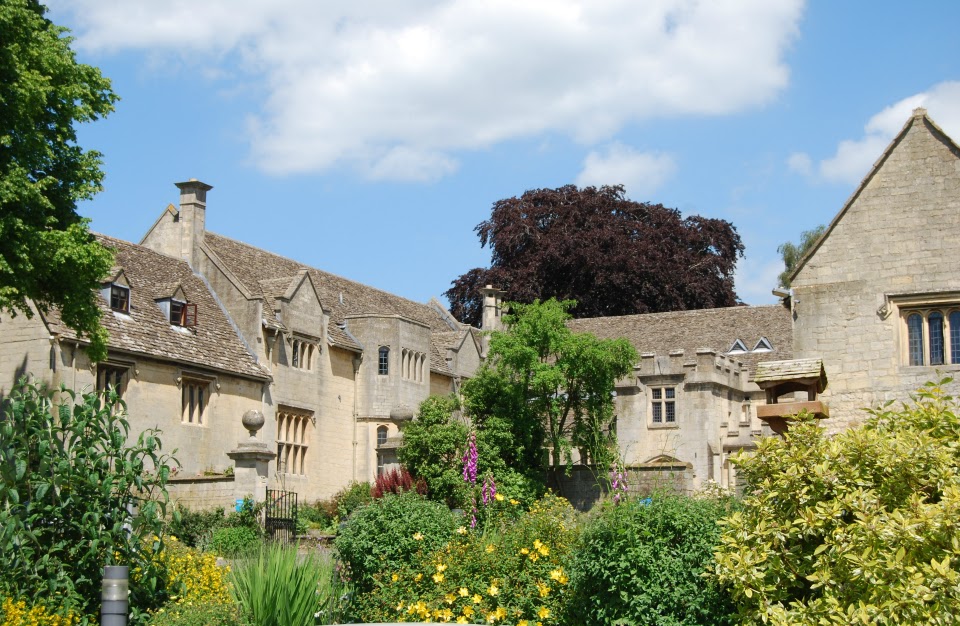
Part of Leckhampton Court in the modern day

These Norwoods were royalists during the English Civil War. When their cause was defeated and King Charles I was executed, they suffered for having chosen the losing side. The family ran into serious financial difficulties. Francis Norwood, Sr. could no longer afford to keep up Leckhampton Court and sold it to his cousin Henry Norwood. Henry Norwood was a soldier and a staunch royalist during the English Civil War. When the royalists were defeated, Henry continued to be involved in Royalist uprisings, and as a result, spent years imprisoned in the Tower of London before fleeing England for Virginia. He was able to purchase Leckhampton Court from his cousin Francis, and when the monarchy was restored and King Charles II took the throne, Henry returned to England and returned the glory to his family name, becoming the Mayor of Gloucester in 1672, and a Member of Parliament in 1675. Henry had no children, though, and when he died, Leckhampton Court returned to the possession of Francis Norwood Sr.'s branch of the family. Francis had also died in the intervening years, so the estate passed to his sons. My tenth great-grandfather was already in America at that time, so even if he was the son of Francis Norwood, Sr., he would not have been in England to inherit the estate.  

That is one version of the story. 

An English genealogist named G. Marion Norwood Callam wrote a three-volume set of books entitled "The Norwoods," and in it she claimed that Francis Norwood was the son of Captain Thomas Norwood, Thomas was a part of the Leckhampton Court Norwood family, but on a different line than Francis Norwood, Sr. 

The execution of King Charles I at Whitehall in 1649.

There is another possibility, as well.

In the early 1800s, Francis Norwood's descendant Ebenezer Pool wrote a letter to his grandson explaining the Norwood family's history. In it, he claimed that Francis' father was a judge and a "regicide," a term used for someone involved in the killing of a monarch. This story was that Judge Norwood was one of the advisors who decided to put King Charles I to death after the royalists lost the English Civil War. When the monarchy was restored and Charles II took the throne, Judge Norwood was imprisoned and his Essex estate was confiscated. His family fled England, fearing for their lives, and having lost all their property. If this is correct, then Francis was not the son of Francis Norwood, Sr., for that Francis was a royalist and not a judge. He was also not the son of Captain Thomas Norwood, another royalist associated with Leckhampton Court.

This third version of events is supported by author John J. Babson in History of the Town of Gloucester: Cape Ann, Including the Town of Rockport:
Francis Norwood, according to a tradition in the family, fled from England with his father, at the restoration of Charles II, on account of the trouble in which the father feared they might be involved for the part he had taken in the civil wars of that period.

While this version of events makes sense, there is no direct evidence of it. In fact, no Norwood appears on the official lists of those involved in the execution of Charles I. There were 59 judges who signed papers condemning Charles I to death, and many associates who also faced consequences when the monarchy was restored. None of them were named Norwood.

The arrival of DNA research in modern times has further complicated (or perhaps clarified) the matter. This discussion on Geni.com explains the testing that has been done in some detail on groups of Americans with the surname Norwood. Of all the different family groups that were tested, only one, the descendants of William Norwood of Virginia, appear to have a connection with the Norwoods of Leckhampton Court. The result:
We have several unrelated families and some researchers want to show they have a common ancestor and they do not. At least seven different families in America descend from an ancestor that took the name Norwood independently. But the genetic evidence proves that they are not descended from the same Norwood ancestor and the genealogy is incorrect.
Francis Norwood was almost certainly not the son of Francis Norwood, Sr. of Leckhampton Court, given the DNA evidence. So, who was he? It's possible he was the son of a judge with the surname Norwood, but almost certainly not a judge who sentenced Charles I to death. It's possible he was descended from some other, less notable, Norwood. It's also plausible that he simply adopted the surname Norwood and created a tale around it, happy to let his Massachusetts neighbors believe he had a more colorful ancestry than he actually did. At this point in time, there's no way to know. Francis Norwood arrived in Lynn, Massachusetts from England, ran a tavern and raised a family in Gloucester, and his backstory is lost to history.

A modern view of Gloucester, Massachusetts

Francis married Elizabeth Coldham on October 15, 1663 in Gloucester, Massachusetts. This would have been a socially advantageous marriage for Francis. His new father-in-law and his family had established strong roots in Gloucester and were serving in leadership roles in their community. For Francis, who had arrived in the New World alone and with questionable roots, marrying a Coldham gave him a little more legitimacy. 

In 1664, Francis bought six acres of land in Goose Cove and built a house there. He and Elizabeth had ten children between 1664 and 1689.

1. Thomas Norwood (b. 1664; m. Mary Brown; d. 1755)
2. Francis Norwood, Jr. (b. 1666; m. Mary Stevens; d. 1709)
3. Elizabeth Norwood (b. 1668; m. John Potter; d. 1709)
4, Mary Norwood (b. 1672; m. Samuel Sargent; d. 1718)
5. Stephen Norwood (b. 1674; m. Elizabeth; d. 1703)
6. Deborah Norwood (b. 1677; m. (1) Benjamin Harraden (2) Joseph York; d. 1742)
7. Hannah Norwood (b. 1679; d. 1679)
8. Joshua Norwood (b. 1683; m. Elizabeth Andrews; d. 1762)
9. Caleb Norwood (b. 1685; m. Alice Donnall; d. 1735)
10. Abigail Norwood (b. 1689; m. Nathaniel Elery; d. 1711)

Nine of Francis and Elizabeth's ten children lived to adulthood, and all of those surviving Norwoods married. This means Francis and Elizabeth have many, many descendants. Perhaps the true story of the Norwood origins passed down along one of those branches and will someday be shared. It's also entirely possible that Francis Norwood arrived in America determined to reinvent himself, and the truth of his origins died with him.

Francis Norwood passed away on March 4, 1709, at the age of 74. Elizabeth survived him, dying two years later, in 1711. 

Monday, February 13, 2023

The Coldham Family of Gloucester, Massachusetts

A view of modern day Gloucester, Massachusetts

While researching the Coldham family of Gloucester, Massachusetts, I came across the following details about my 11th great-grandfather, Clement Coldham. It is perhaps my favorite description ever of a person in my family tree.

Like his father, he [Clement Coldham] was a miller; he was also a farmer, a constable, a member of Boston's Ancient Artillery Company, and, according to James G. Dempsey (1971, The New England Historical and Genealogical Register), an indefatigable "self-appointed overseer of Gloucester townspeople and their morals." Dempsey's article devotes nearly two pages of tiny type to accounts of Clement Coldham snooping on his neighbors, complaining against them, testifying in court to their perfidiousness, accusing them of disloyalty to the King, suing them for slander, and occasionally being himself admonished in court for telling lies. At one point, he even spied on his own brother-in-law. Despite everything we know about human misbehavior in late 17th-century Essex County, most notably the Salem "witchcraft" madness of 1692, the fact that Clement Coldham lived to a prosperous old age instead of being stuffed down a well is a testimony to the equanimity and moderation of these early settlers. [source] (Paragraph edited for clarity and context)

The Clements were early English emigrants to America on my Smith branch of the family tree. This line is peppered with loyalists, religious fanatics, and generally people not much appreciated by their neighbors. 

Clement's father, Thomas Coldham is my immigrant ancestor on the Coldham line, and my 12th great grandfather. Thomas was born about 1589 in England, possibly Norfolk, and emigrated to the Massachusetts Bay Colony sometime around 1633. He was married in England (this wife's name is unknown) and had at least three children there:

1. Clement Coldham (b. 1625; m. Mary Pierce; d. 1703)
2. Enoch Coldham (b. abt. 1630)
3. Martha Coldham (b. abt. 1631; m. Richard Whitney)

There were at least two additional children born in or near Lynn, Massachusetts, where the Coldham family settled upon their arrival.

4. Mary Coldham (b. abt. 1634)
5. Thomas Coldham (b. abt. 1638; d. 1675)

After the death of his first wife, Thomas married again in America, to a woman named Joanna. Her maiden name is sometimes said to be Rhodes, due to the fact that Thomas mentioned a "brother" Henrye Rhodes in his will, but this is not proven.

The cities of Lynn, Salem, and Gloucester in Massachusetts


Thomas' eldest child, Clement, married Mary Pierce in about 1647. Mary was born in Norwich, Norfolk, England, the daughter of John Pierce and his wife Elizabeth. Clement and Mary had three children together:

1. Clement Coldham, Jr. (b. 1641; d. 1675)
2. Elizabeth Coldham (b. 1645; m. Francis Norwood; d. 1711)
3. Judith Coldham (b. 1649; d. 1649)

Clement and Mary settled in Gloucester, northeast of Lynn. I have been pleased to recently discover several ancestors from Gloucester in my family tree, including Clement. Gloucester is a place I've always felt a particular connection to, for no reason I can clearly define. When in college in Massachusetts, I loved to visit the Cape Ann beaches, and every time I return to Massachusetts now, I always make sure to stop in Gloucester. 

Clement quickly set about making a name for himself in Gloucester. He is first mentioned in the Quarterly Court records on September 11, 1649, as a witness to the beating of Richard Stocker by Thomas Farrar. I have not been able to find information about this conflict, but given the report of Clement's character, I am not surprised to hear he was in the middle of it. 

In 1651, Clement and his young family settled in a house near Goose Cove, on the north end of Gloucester. In 1653, at the age of 28, he was elected Deputy in Gloucester. He would later be elected Selectman. 

Painting of a militia in Massachusetts Bay, 1600s

Clement served in his local militia in Gloucester. At that time, regional militias were primarily formed to engage with local Native American groups when there were no British military troops nearby to do so. Clement's service began in about 1649, and he earned the rank of ensign. In 1666, Clement was suddenly stripped of that rank, and then quit the militia in protest. I haven't seen any explanation for his demotion. It could be as simple as the fact that he was disliked. I have seen some speculation that his daughter Elizabeth's marriage to Francis Norwood in 1663 was frowned upon locally. I don't know why there would have been a reaction to this three years after the marriage, but it's possible.
Coldham's fall from grace could have been brought about by his new son-in-law, Francis Norwood, Sr. Norwood had come to New England after the restoration of the Stuart monarchy made England an inhospitable environment for someone with his radical religious and political convictions. He first kept a tavern in Lynn, a center of early Baptist and Quaker enthusiasm, but after a few years, he settled in Gloucester at Goose Cove amidst the Quaker Pearces and Hammonds and the Congregationalist Coldhams. In 1663 he married Clement Coldham's daughter. [source: Christine Heyrman, 1984]
Francis Norwood is my 10th great-grandfather and I will be discussing his complicated family in an upcoming post.

Clement was a Congregationalist. Encyclopedia Brittanica describes this religion as follows.
[Congregationalism was a] Christian movement that arose in England in the late 16th and 17th centuries. It occupies a theological position somewhere between Presbyterianism and the more radical Protestantism of the Baptists and Quakers. It emphasizes the right and responsibility of each properly organized congregation to determine its own affairs, without having to submit these decisions to the judgment of any higher human authority, and as such it eliminated bishops and presbyteries. Each individual church is regarded as independent and autonomous.

Although it was not always true in the early days in America, Congregationalists have generally been distrustful of state establishment of religion and have worked for civil and religious liberty. Their emphasis on the rights of the particular congregation and on freedom of conscience arose from their strong convictions concerning the sovereignty of God and the priesthood of all believers. 

James G. Dempsey's 1971 article about the Coldham family in The New England Historical and Genealogical Register relates that Clement Coldham was involved in the Salem Witch Trials, like my Eveleth ancestors, who lived nearby. In 1692, during the witchcraft hysteria, Clement was about 67 years of age. Dempsey does not describe the breadth of Clement's involvement in the witchcraft trials, but just one moment where he testified in a trial involving Elizabeth Hubbard. Young Elizabeth was an accuser in the witch trials, and she famously pretended to be in a trance during the trial of Elizabeth Proctor, wife of my husband's 9th great-granduncle, John Proctor. 

Elizabeth Hubbard is best known as the primary instigator of the Salem Witch Trials. Hubbard was 17 years old in the spring of 1692 when the trials began. In the 15 months the trials took place, 20 people were executed.

As the trials progressed, Hubbard began instigating more and more accusations. She gave her last testimony on January 7, 1693. Records show that she filed 40 legal complaints and testified 32 times. As a result of her testimonies, 17 people were arrested, 13 were hanged, and two died in jail. (Wikipedia)

While it seems evident that Clement enjoyed finding himself in a court room, this was undoubtedly the most consequential of his many appearances there, being an actual life and death situation for many. Dempsey related the following about the occasion, quoting from the Essex Institute Historical Collection:

... he deposed that on May 29th 1692, being at Salem Village, carrying home Elizabeth Hubbard from the meeting behind me -- she desired me to ride faster -- I asked her why; she said that the woods were full of Devils and said there they be! but I could see none. Then I put on my horse and after I had ridden awhile she told me I might ride softer for we had outridden them. 

May 29th would have towards the start of what was known as the Court of Oyer and Terminer, formalized witchcraft proceedings after some months of less formal hearings and imprisonments. 

May 27, 1692: Governor Phips sets up the Court of Oyer and Terminer to try witchcraft cases. Judgement is based on intangible evidence, such as confessions, supernatural attributes like "witchmarks", reactions of the afflicted girls, and spectral evidence- that the Devil could assume the "specter" of an innocent person. (source)

It is not clear whether Clement's testimony was in support of any party, or whether it merely related an incident supporting the idea that Elizabeth Hubbard could sense the presence of witches.

An artwork depicting the Salem Witch Trials

Clement Coldham died on December 18, 1703, at the age of 78. He was a complicated, seemingly unlikeable person living during a dramatic moment in history. He may not have been the best neighbor, but through his daughter Elizabeth, he has many, many American descendants. May we all spend less time in court than Clement did.